What Is Quantum Computing? A Complete Beginner’s Guide (2026)
Meta Description
Learn what quantum computing is, how it works, qubits, quantum mechanics, advantages, challenges, real-world applications, and future trends in this complete beginner-friendly guide.
Focus Keyword: What Is Quantum Computing
SEO Slug: what-is-quantum-computing
URL Suggestion:https://tech.menu.hunt.blog/what-is-quantum-computing
Primary Keyword: What Is Quantum Computing
Secondary Keywords:
- Quantum Computing Explained
- Quantum Computer
- Qubits
- Quantum Mechanics
- Superposition
- Quantum Entanglement
- Quantum Computing for Beginners
- Future of Quantum Computing
- Quantum vs Classical Computers
- Quantum Technology
Estimated Reading Time: 12–14 Minutes
What Is Quantum Computing? A Complete Beginner’s Guide (2026)
Quantum computing is one of the most exciting and rapidly developing technologies of the 21st century. While traditional computers have transformed the digital world over the past several decades, quantum computers promise to solve certain complex problems much faster than even today’s most powerful supercomputers.
Although quantum computing may sound like science fiction, governments, universities, and technology companies around the world are investing billions of dollars into its development. Researchers believe that quantum computers could revolutionize fields such as medicine, artificial intelligence, cybersecurity, climate modeling, and financial analysis.
Understanding quantum computing does not require a background in physics. By learning a few basic concepts, anyone can appreciate why this technology has attracted so much attention.
In this beginner-friendly guide, you’ll discover what quantum computing is, how it works, the meaning of qubits, superposition, and entanglement, its advantages, challenges, real-world applications, and the future of this groundbreaking technology.
What Is Quantum Computing?
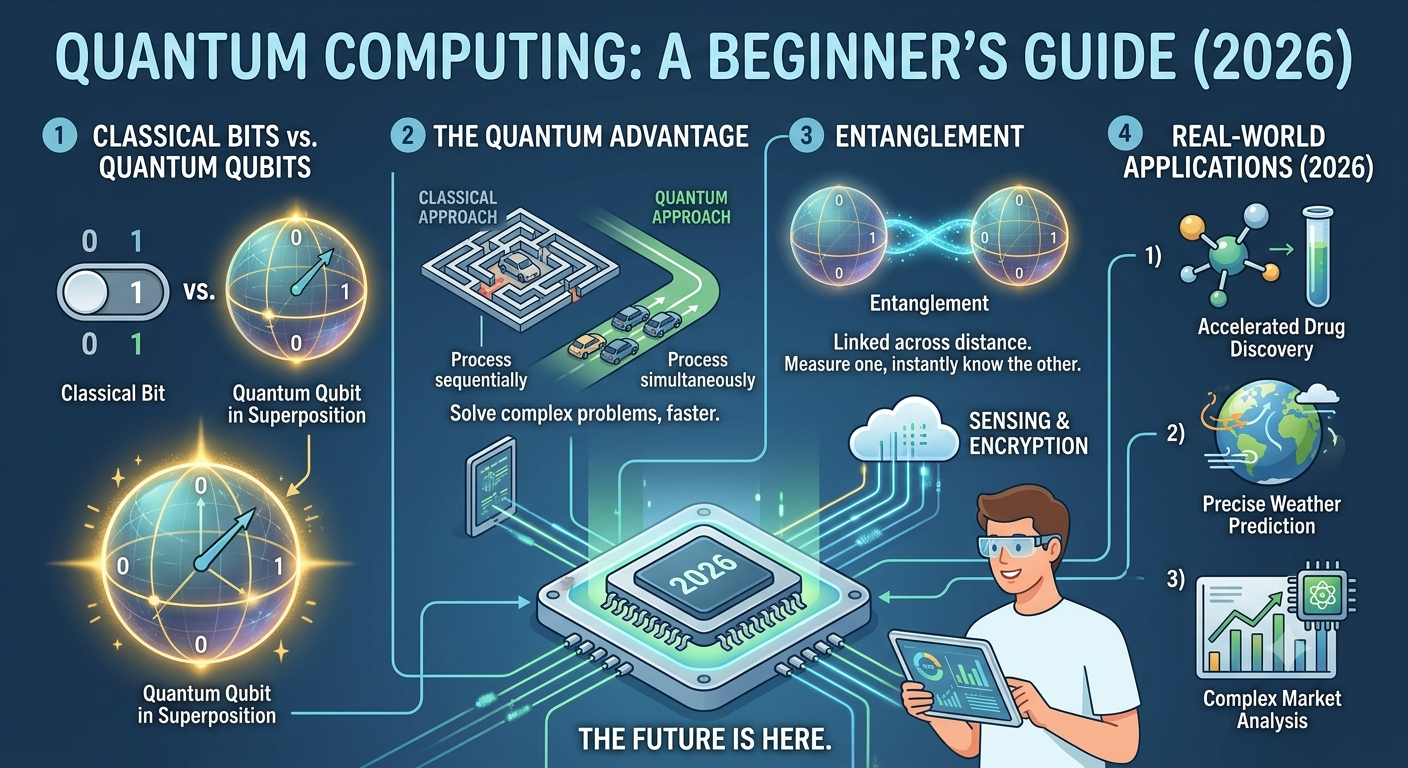
Quantum computing is a type of computing that uses the principles of quantum mechanics to process information.
Unlike traditional computers that use bits, quantum computers use qubits (quantum bits).
A traditional bit can only have one value at a time:
- 0
- 1
A qubit can exist in multiple states simultaneously through a property called superposition.
Because of this unique ability, quantum computers can perform certain calculations far more efficiently than classical computers.
How Does Quantum Computing Work?
Quantum computers process information differently from traditional computers.
Instead of simply switching electrical signals on or off, they manipulate quantum particles using specialized hardware and quantum algorithms.
Here’s a simplified overview.
Step 1: Creating Qubits
Quantum computers create qubits using extremely small particles such as electrons, photons, or superconducting circuits.
These qubits serve as the basic unit of quantum information.
Step 2: Superposition
Unlike classical bits, qubits can represent multiple possibilities at the same time.
This allows quantum computers to explore many potential solutions simultaneously.
Step 3: Entanglement
Qubits can become linked through a phenomenon called quantum entanglement.
When qubits are entangled, changing one can instantly influence another, even when separated by large distances.
This property enables highly coordinated computations.
Step 4: Quantum Operations
Quantum gates manipulate qubits to perform calculations.
These operations allow the computer to process complex mathematical problems efficiently.
Step 5: Measurement
Once calculations are complete, the quantum state is measured to produce a final result that can be interpreted by users.
What Is a Qubit?
A qubit (quantum bit) is the fundamental building block of a quantum computer.
Unlike a regular computer bit that stores either 0 or 1, a qubit can represent combinations of both until it is measured.
This capability dramatically increases computational potential for specific types of problems.
Key Principles of Quantum Computing
Quantum computing relies on several important concepts.
Superposition
Superposition allows qubits to exist in multiple states simultaneously.
Instead of testing one possibility at a time, quantum computers evaluate many possibilities in parallel.
Quantum Entanglement
Entanglement creates a strong connection between qubits.
This relationship enables quantum systems to coordinate calculations with remarkable efficiency.
Quantum Interference
Quantum interference helps strengthen correct solutions while reducing incorrect ones during computation.
This improves the accuracy of many quantum algorithms.
Quantum Computers vs Classical Computers
| Feature | Quantum Computer | Classical Computer |
|---|---|---|
| Basic Unit | Qubit | Bit |
| Values | Multiple States | 0 or 1 |
| Processing Style | Parallel Possibilities | Sequential Processing |
| Speed | Extremely Fast for Certain Problems | Fast for Everyday Tasks |
| Best For | Optimization, Simulation, Cryptography | General Computing |
| Technology | Quantum Mechanics | Electronic Circuits |
Both technologies have strengths and are expected to complement each other rather than completely replace one another.
Advantages of Quantum Computing
Quantum computing offers several significant advantages.
Extremely Fast Calculations
Certain complex calculations can be completed much faster than with traditional computers.
Better Optimization
Quantum computers can solve optimization problems involving many possible solutions more efficiently.
Applications include logistics, transportation, and manufacturing.
Drug Discovery
Scientists can simulate molecular interactions more accurately, helping accelerate medical research and pharmaceutical development.
Artificial Intelligence
Quantum computing could significantly improve machine learning algorithms and data analysis.
Climate Modeling
Researchers may use quantum computers to better predict weather patterns and study climate change.
Challenges of Quantum Computing
Despite its enormous potential, quantum computing faces several challenges.
Hardware Complexity
Quantum computers require extremely specialized hardware.
Many systems operate at temperatures close to absolute zero.
Error Rates
Qubits are highly sensitive to environmental interference, making error correction a major research area.
High Cost
Developing and maintaining quantum computers remains very expensive.
Limited Commercial Availability
Quantum computing is still in its early stages and is not yet suitable for most everyday consumer applications.
Real-World Applications of Quantum Computing
Although still developing, quantum computing has many promising applications.
Healthcare
Researchers use quantum simulations to develop new medicines and study complex diseases.
Cybersecurity
Quantum computing may both challenge and improve modern encryption systems.
This has led to research into quantum-resistant cryptography.
Financial Services
Banks can use quantum algorithms for:
- Portfolio optimization
- Fraud detection
- Risk analysis
- Market simulations
Artificial Intelligence
Quantum computing may improve:
- Machine learning
- Pattern recognition
- Data analysis
- Natural language processing
Logistics
Companies can optimize:
- Delivery routes
- Supply chains
- Warehouse management
- Transportation planning
Scientific Research
Quantum simulations help researchers study chemistry, materials science, and particle physics.
Which Companies Are Investing in Quantum Computing?
Many leading technology companies and research organizations are actively developing quantum computing technologies.
Major industry participants include:
- IBM
- Microsoft
- Intel
- Amazon
- NVIDIA
- IonQ
- Rigetti Computing
Governments and universities worldwide are also investing heavily in quantum research.
Will Quantum Computers Replace Traditional Computers?
No—not completely.
Quantum computers excel at solving specific complex mathematical problems.
Traditional computers remain far better for everyday activities such as:
- Web browsing
- Gaming
- Office work
- Video editing
- Social media
In the future, classical and quantum computers are expected to work together.
Future of Quantum Computing
Experts believe quantum computing will continue advancing throughout the next decade.
Expected developments include:
- More stable qubits
- Improved error correction
- Quantum internet research
- Faster quantum processors
- Better encryption technologies
- Commercial quantum cloud services
- Scientific breakthroughs
- Advanced AI integration
Although mainstream adoption may still take time, the long-term potential is enormous.
Frequently Asked Questions (FAQs)
What is quantum computing in simple words?
Quantum computing is a new type of computing that uses quantum mechanics to solve certain problems much faster than traditional computers.
What is a qubit?
A qubit is the basic unit of information in a quantum computer and can exist in multiple states at the same time.
Is quantum computing available today?
Yes, but current quantum computers are mainly used for research and specialized applications.
Can quantum computers break encryption?
Some current encryption methods could become vulnerable to future quantum computers, which is why researchers are developing quantum-resistant encryption techniques.
Is quantum computing the future?
Many experts believe quantum computing will play an important role in science, medicine, cybersecurity, and Artificial Intelligence, although classical computers will continue to be essential.
Conclusion
Quantum computing represents a major leap forward in computing technology. By using qubits and the principles of quantum mechanics, these powerful machines have the potential to solve problems that are beyond the capabilities of today’s classical computers.
While the technology is still evolving, its possible applications in healthcare, finance, cybersecurity, logistics, and Artificial Intelligence make it one of the most exciting areas of research. As hardware improves and quantum systems become more practical, quantum computing is expected to unlock new scientific discoveries and transform industries across the globe.
Learning the fundamentals of quantum computing today provides valuable insight into one of the technologies that could shape the future of innovation.
SEO Checklist
Primary Keyword
- What Is Quantum Computing ✅
Secondary Keywords Used
- Quantum Computing Explained ✅
- Quantum Computer ✅
- Qubits ✅
- Superposition ✅
- Quantum Entanglement ✅
- Quantum Mechanics ✅
- Quantum vs Classical Computers ✅
- Quantum Technology ✅
- Future of Quantum Computing ✅
Suggested Image Alt Texts
- Quantum Computing explained infographic
- Qubit vs Bit comparison diagram
- Quantum Computer architecture illustration
- Superposition and Entanglement visualization
- Quantum vs Classical Computer comparison
Internal Linking Suggestions
Link this article to your previous posts:
- What Is Artificial Intelligence?
- What Is Machine Learning?
- What Is Blockchain Technology?
- What Is Cloud Computing?
- What Is Cybersecurity?
- Best AI Tools in 2026
- How Does ChatGPT Work?
Future Internal Links
- What Is Quantum Mechanics?
- What Is Edge Computing?
- What Is the Internet of Things (IoT)?
- What Is 5G Technology?
- What Is Generative AI?
- Future Technology Trends in 2030
SEO Tip: “What Is Quantum Computing?” is a high-value evergreen topic. Updating the article as new breakthroughs occur and adding comparison charts or diagrams can improve user engagement and search rankings.