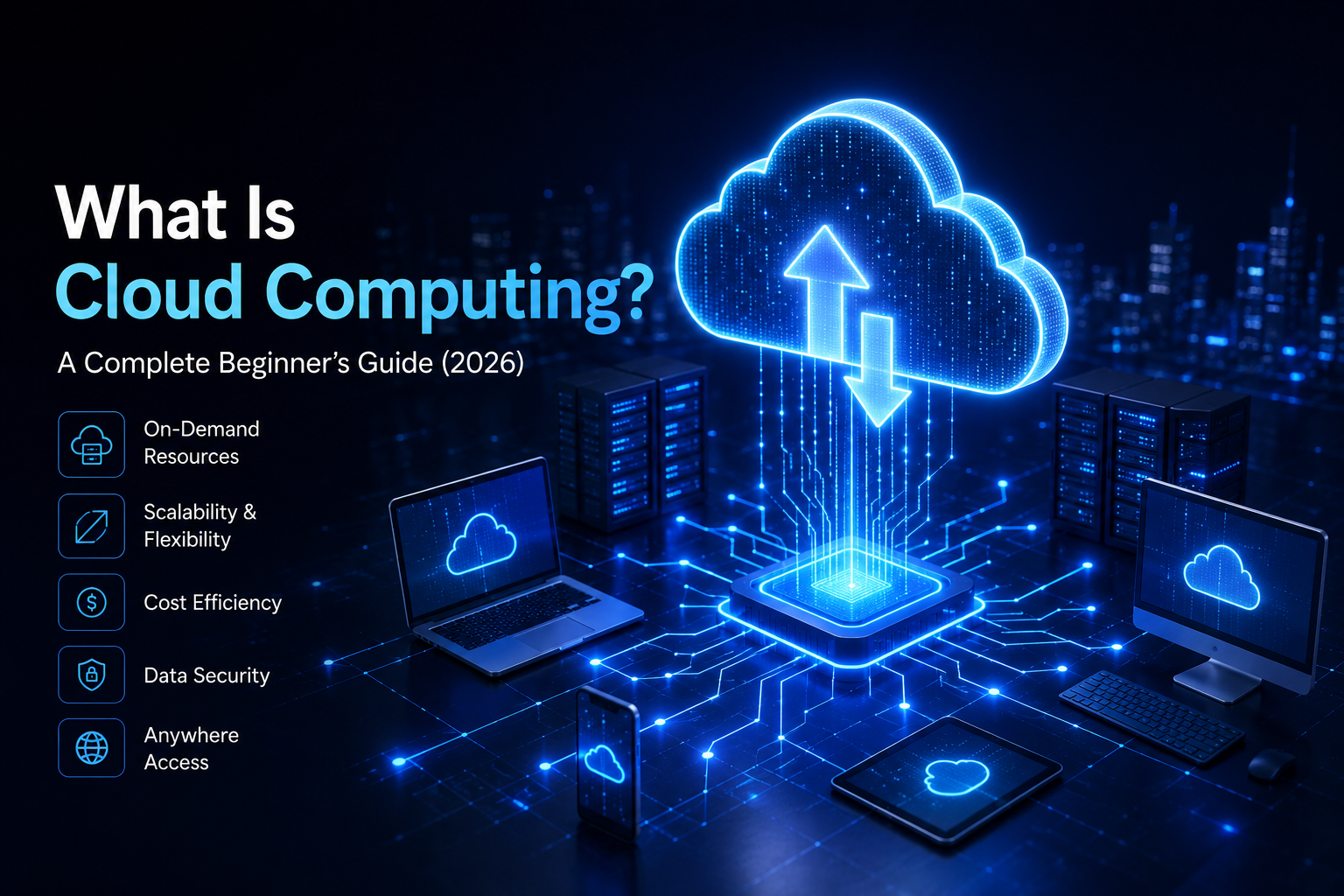
Meta Description
Learn what cloud computing is, how it works, its types, benefits, challenges, real-world applications, and future trends. A complete SEO-friendly beginner’s guide for 2026.
Focus Keyword: What Is Cloud Computing
SEO Slug: what-is-cloud-computing
URL Suggestion:https://tech.menu.hunt.blog/what-is-cloud-computing
Primary Keyword Density: 1–1.5%
Secondary Keywords:
- Cloud Computing Explained
- Types of Cloud Computing
- Cloud Services
- Cloud Storage
- Public Cloud
- Private Cloud
- Hybrid Cloud
- Benefits of Cloud Computing
- Cloud Computing for Beginners
- Future of Cloud Computing
Estimated Reading Time: 10–12 Minutes
What Is Cloud Computing? A Complete Beginner’s Guide (2026)
Cloud computing has transformed the way individuals and businesses use technology. Instead of relying on expensive physical servers and storage devices, organizations can now access computing resources over the internet whenever they need them.
Whether you’re streaming movies, saving photos to cloud storage, using online office software, or hosting a website, you’re already benefiting from cloud computing.
Over the past decade, cloud technology has become the backbone of digital transformation. Companies of all sizes use cloud computing to reduce costs, improve scalability, increase security, and enable remote work. As businesses continue moving their operations online, understanding cloud computing has become an essential skill for students, professionals, and entrepreneurs alike.
In this comprehensive guide, you’ll learn what cloud computing is, how it works, its different service models, deployment types, benefits, disadvantages, real-world applications, and why it will continue shaping the future of technology.
What Is Cloud Computing?
Cloud computing is the delivery of computing services over the internet instead of using local computers or physical servers.
These services include:
- Data storage
- Servers
- Databases
- Networking
- Software
- Analytics
- Artificial Intelligence
- Security
Instead of buying expensive hardware, users can rent computing resources from cloud providers and pay only for what they use.
This flexibility makes cloud computing one of the most cost-effective technologies available today.
How Does Cloud Computing Work?
Cloud computing works by storing applications and data on remote servers owned by cloud service providers.
When you access an online service, your device communicates with these remote servers through the internet.
Here’s a simple process:
Step 1: User Requests a Service
A user opens an application, uploads a file, or visits a website.
Step 2: Request Reaches the Cloud
The request is sent to powerful data centers located around the world.
These data centers contain thousands of servers working together.
Step 3: Processing
The cloud servers process the request, retrieve the required information, and perform any necessary calculations.
Step 4: Response
The requested data is securely sent back to the user’s device within seconds.
This entire process happens almost instantly.
Key Characteristics of Cloud Computing
Cloud computing offers several important features.
On-Demand Access
Users can access computing resources whenever needed without purchasing hardware.
Scalability
Resources can easily increase or decrease depending on business requirements.
For example, an online store can automatically handle increased traffic during holiday sales.
Pay-As-You-Go Pricing
Organizations only pay for the resources they actually use.
This reduces unnecessary expenses.
High Availability
Cloud providers maintain multiple data centers to ensure services remain available even if one location experiences problems.
Automatic Updates
Cloud providers regularly update software, security patches, and infrastructure without requiring user intervention.
Types of Cloud Computing
Cloud computing can be divided into four deployment models.
1. Public Cloud
Public cloud services are owned and operated by third-party providers.
Resources are shared among multiple customers.
Examples include hosting websites and online storage services.
Advantages:
- Lower cost
- Easy setup
- High scalability
2. Private Cloud
Private cloud infrastructure is dedicated to a single organization.
It provides greater control, security, and customization.
Commonly used by:
- Banks
- Government agencies
- Large enterprises
3. Hybrid Cloud
Hybrid cloud combines public and private cloud environments.
Organizations can keep sensitive information on private servers while using the public cloud for less critical workloads.
4. Multi-Cloud
Multi-cloud refers to using services from multiple cloud providers simultaneously.
This strategy improves reliability and reduces dependency on one provider.
Cloud Service Models
Cloud providers offer three primary service models.
Infrastructure as a Service (IaaS)
IaaS provides virtual servers, networking, and storage.
Customers manage the operating system and applications while the provider manages the hardware.
Examples include:
- Virtual machines
- Cloud storage
- Networking services
Platform as a Service (PaaS)
PaaS provides developers with a complete platform for building and deploying applications.
It removes the need to manage hardware and operating systems.
Ideal for software developers.
Software as a Service (SaaS)
SaaS delivers software directly through web browsers.
Users simply sign in and start using the application.
Examples include:
- Email services
- Online office suites
- Video conferencing platforms
- Customer relationship management software
Real-World Applications of Cloud Computing
Cloud computing powers many everyday technologies.
Cloud Storage
Services allow users to securely store documents, photos, videos, and backups online.
Website Hosting
Most modern websites run on cloud infrastructure because it offers better reliability and scalability.
Streaming Services
Movies, TV shows, and music streaming platforms rely heavily on cloud computing to deliver content worldwide.
Business Collaboration
Teams use cloud-based applications for:
- File sharing
- Video meetings
- Project management
- Real-time collaboration
Healthcare
Hospitals use cloud computing to securely manage:
- Electronic health records
- Medical imaging
- Patient information
- Telemedicine services
Education
Educational institutions use cloud platforms for:
- Online learning
- Digital classrooms
- Assignment submissions
- Virtual labs
Benefits of Cloud Computing
Cloud computing offers numerous advantages.
Cost Savings
Businesses avoid purchasing expensive servers and hardware.
Flexibility
Employees can access applications from almost anywhere with an internet connection.
Improved Security
Leading cloud providers invest heavily in cybersecurity technologies and data protection.
Disaster Recovery
Cloud backups protect organizations against hardware failures, cyberattacks, and natural disasters.
Faster Deployment
Businesses can launch new applications within minutes instead of waiting weeks for physical infrastructure.
Better Performance
Modern cloud data centers use advanced hardware to deliver fast and reliable performance.
Challenges of Cloud Computing
Although cloud computing offers many benefits, there are also some challenges.
Internet Dependency
Most cloud services require a reliable internet connection.
Without internet access, some services become unavailable.
Data Privacy
Organizations must carefully manage sensitive information and comply with privacy regulations.
Vendor Lock-In
Moving applications from one cloud provider to another can sometimes be difficult.
Downtime
Although rare, cloud providers may occasionally experience service outages.
Businesses often prepare backup plans for critical systems.
Cloud Computing vs Traditional Computing
| Feature | Cloud Computing | Traditional Computing |
|---|---|---|
| Initial Cost | Low | High |
| Maintenance | Provider | User |
| Scalability | Easy | Limited |
| Accessibility | Anywhere | Usually Local |
| Software Updates | Automatic | Manual |
| Hardware Purchase | Not Required | Required |
Popular Uses of Cloud Computing
Many industries depend on cloud technology every day.
Examples include:
- Online banking
- Mobile applications
- Artificial Intelligence
- Machine Learning
- Website hosting
- E-commerce
- Online gaming
- Video streaming
- Data backup
- Email services
Cloud computing has become the foundation of the modern internet.
Future of Cloud Computing
The future of cloud computing looks incredibly promising.
Emerging technologies expected to drive growth include:
- Artificial Intelligence integration
- Edge Computing
- Quantum Computing
- Serverless Computing
- Internet of Things (IoT)
- 5G networks
- Green cloud infrastructure
- Multi-cloud management
Businesses will continue adopting cloud solutions to improve efficiency, security, and innovation.
Frequently Asked Questions (FAQs)
What is cloud computing in simple words?
Cloud computing means using computing resources like storage, software, and servers over the internet instead of owning physical hardware.
Is cloud computing safe?
Yes. Most major cloud providers use advanced encryption, multi-factor authentication, and security monitoring to protect customer data.
What are the three main cloud service models?
The three primary models are:
- Infrastructure as a Service (IaaS)
- Platform as a Service (PaaS)
- Software as a Service (SaaS)
What are examples of cloud computing?
Examples include:
- Online file storage
- Streaming services
- Email platforms
- Website hosting
- Video conferencing
- Online collaboration tools
Why is cloud computing important?
Cloud computing reduces costs, improves flexibility, enables remote work, and allows businesses to scale their operations quickly.
Conclusion
Cloud computing has fundamentally changed the way technology is delivered and consumed. By providing on-demand access to computing resources over the internet, it enables businesses and individuals to work more efficiently, reduce costs, and innovate faster than ever before.
From startups launching websites to global enterprises managing millions of users, cloud computing powers much of today’s digital world. As technologies such as Artificial Intelligence, Machine Learning, and the Internet of Things continue to evolve, cloud computing will remain at the center of modern innovation.
Understanding the basics of cloud computing is an excellent first step toward building future-ready technical skills and exploring career opportunities in one of the fastest-growing areas of information technology.
SEO Checklist
Primary Keyword: What Is Cloud Computing ✅
Secondary Keywords Used:
- Cloud Computing Explained ✅
- Cloud Services ✅
- Types of Cloud Computing ✅
- Cloud Storage ✅
- Public Cloud ✅
- Private Cloud ✅
- Hybrid Cloud ✅
- Benefits of Cloud Computing ✅
- Cloud Computing for Beginners ✅
- Future of Cloud Computing ✅
Suggested Image Alt Texts:
- What Is Cloud Computing infographic
- Cloud Computing architecture diagram
- Types of Cloud Computing explained
- Cloud Service Models (IaaS, PaaS, SaaS)
- Cloud Computing vs Traditional Computing comparison
Internal Linking Suggestions:
- What Is Artificial Intelligence? A Complete Beginner’s Guide (2026)
- What Is Machine Learning? A Complete Beginner’s Guide (2026)
- What Is Blockchain Technology? A Complete Beginner’s Guide (2026)
External Authority References (for citations if you add them later):
- National Institute of Standards and Technology (NIST)
- Amazon Web Services (AWS)
- Microsoft Azure
- Google Cloud
This article is optimized for beginner-focused search intent and is structured to perform well for long-tail queries while remaining easy to read.