What Is Blockchain Technology? A Complete Beginner’s Guide (2026)
Meta Description
Discover what blockchain technology is, how it works, its benefits, types, real-world applications, challenges, and future trends in this complete beginner-friendly guide.
Focus Keyword: What Is Blockchain Technology
SEO Slug: what-is-blockchain-technology
Estimated Reading Time: 9–11 Minutes
What Is Blockchain Technology? A Complete Beginner’s Guide (2026)
Blockchain technology has become one of the most revolutionary innovations of the digital age. While many people associate blockchain with cryptocurrencies like Bitcoin, its potential extends far beyond digital money. Today, businesses, governments, healthcare organizations, and financial institutions are exploring blockchain to improve security, transparency, and efficiency.
At its core, blockchain is a secure digital ledger that records transactions across multiple computers. Unlike traditional databases controlled by a single organization, blockchain distributes data across a decentralized network, making it extremely difficult to alter or hack.
As cyber threats continue to increase and digital trust becomes more important, blockchain offers a reliable way to store and verify information without relying on a central authority.
In this guide, you’ll learn what blockchain technology is, how it works, its key features, advantages, disadvantages, real-world applications, and why experts believe it will play a major role in the future of technology.
What Is Blockchain Technology?
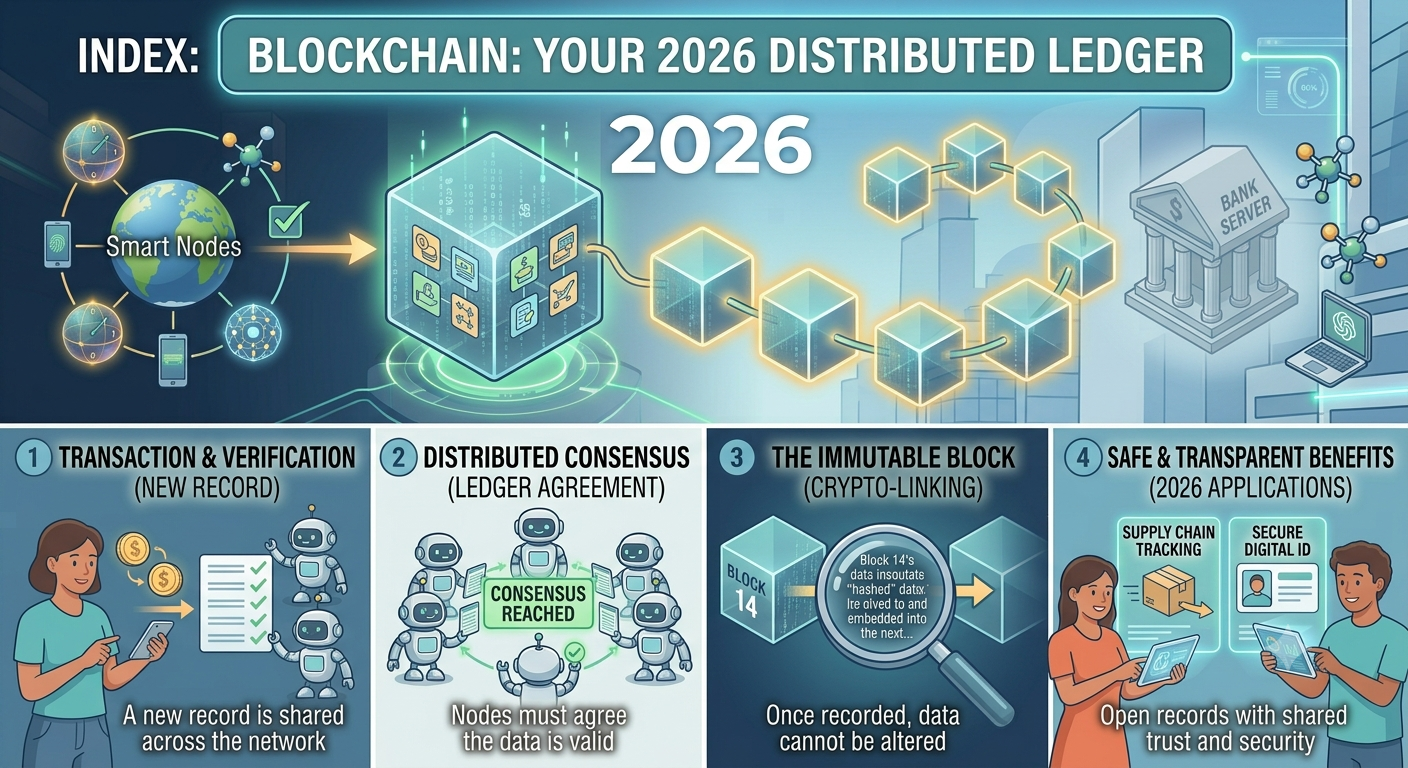
Blockchain is a decentralized digital ledger that securely stores records in a series of connected blocks.
Each block contains:
- Transaction data
- A timestamp
- A unique cryptographic hash
- The hash of the previous block
Because every block is connected to the one before it, changing one record would require changing every block that follows it across thousands of computers—a nearly impossible task on large blockchain networks.
This structure makes blockchain one of the most secure methods of storing digital information.
How Does Blockchain Work?
Understanding blockchain becomes easier when broken into simple steps.
Step 1: A Transaction Begins
A user initiates a transaction.
This could involve:
- Sending cryptocurrency
- Signing a digital contract
- Recording ownership
- Storing medical data
Step 2: The Transaction Is Broadcast
The transaction is sent to a network of computers known as nodes.
Each node independently checks whether the transaction follows the network’s rules.
Step 3: Verification
Using consensus mechanisms, the network verifies that the transaction is valid.
Different blockchains use different verification methods such as:
- Proof of Work (PoW)
- Proof of Stake (PoS)
- Delegated Proof of Stake (DPoS)
Only verified transactions move forward.
Step 4: A New Block Is Created
After validation, approved transactions are grouped into a new digital block.
The block contains all relevant transaction details.
Step 5: The Block Is Added to the Chain
The new block is connected to the previous block using cryptographic hashing.
Once added, the information becomes permanent and extremely difficult to modify.
Key Features of Blockchain
Blockchain offers several unique characteristics that distinguish it from traditional databases.
Decentralization
Instead of storing information on one central server, blockchain distributes copies of the ledger across thousands of computers.
This eliminates a single point of failure.
Transparency
Most public blockchains allow anyone to verify transactions.
This creates trust without requiring a central authority.
Security
Every block is protected using advanced cryptography.
Any attempt to change stored data is immediately detected by the network.
Immutability
Once data is added to the blockchain, it cannot easily be changed or deleted.
This makes blockchain ideal for financial records and legal documents.
Faster Verification
Many blockchain systems automate verification processes, reducing paperwork and manual approvals.
Types of Blockchain
There are four primary types of blockchain networks.
1. Public Blockchain
Anyone can join and participate.
Examples include:
- Bitcoin
- Ethereum
Public blockchains offer maximum transparency but may process transactions more slowly.
2. Private Blockchain
Private blockchains are controlled by a single organization.
Only approved participants can access the network.
They are commonly used by businesses.
3. Consortium Blockchain
A consortium blockchain is managed by multiple organizations rather than one.
Banks and supply chain companies often use this model.
4. Hybrid Blockchain
Hybrid blockchains combine features of both public and private networks.
Organizations can keep sensitive information private while making selected data publicly verifiable.
Real-World Applications of Blockchain
Blockchain is transforming many industries.
Banking and Finance
Banks use blockchain to:
- Speed up international payments
- Reduce fraud
- Lower transaction costs
- Improve security
Supply Chain Management
Companies track products from manufacturing to delivery.
Blockchain helps businesses verify product authenticity and reduce counterfeiting.
Healthcare
Hospitals use blockchain to protect patient records while allowing authorized healthcare providers secure access.
Real Estate
Property ownership records can be stored on blockchain, reducing paperwork and minimizing fraud.
Voting Systems
Blockchain-based voting systems increase transparency and reduce the risk of election tampering.
Digital Identity
Individuals can securely control their personal identity information without relying entirely on centralized databases.
Entertainment
Artists and creators use blockchain to protect copyrights, manage royalties, and sell digital assets directly to fans.
Benefits of Blockchain Technology
Blockchain provides several important advantages.
Enhanced Security
Advanced encryption makes blockchain extremely resistant to hacking.
Greater Transparency
Every verified transaction is recorded permanently, increasing accountability.
Reduced Costs
Removing intermediaries lowers transaction fees and administrative expenses.
Faster Transactions
Many blockchain networks process transactions much faster than traditional banking systems.
Improved Trust
Participants can verify records independently without relying on a single authority.
Challenges of Blockchain
Despite its benefits, blockchain also faces limitations.
Scalability
Some blockchain networks process fewer transactions per second compared to traditional payment systems.
Energy Consumption
Certain consensus mechanisms, especially Proof of Work, require significant electricity.
Many modern blockchains are shifting toward more energy-efficient alternatives.
Regulatory Uncertainty
Governments continue developing laws regarding blockchain and cryptocurrency.
Regulations vary from country to country.
Technical Complexity
Understanding blockchain development requires specialized knowledge in cryptography, networking, and software engineering.
Blockchain vs Traditional Databases
| Feature | Blockchain | Traditional Database |
|---|---|---|
| Control | Decentralized | Centralized |
| Security | Very High | Moderate |
| Transparency | High | Limited |
| Data Modification | Extremely Difficult | Easy |
| Trust | Distributed | Central Authority |
| Failure Risk | Low | Higher |
Blockchain and Cryptocurrency
Many people believe blockchain and cryptocurrency are the same thing.
They are not.
Blockchain is the technology.
Cryptocurrency is one application built using blockchain.
Examples include:
- Bitcoin
- Ethereum
- Solana
- Cardano
Beyond cryptocurrencies, blockchain also supports digital identity, supply chains, healthcare, and smart contracts.
What Are Smart Contracts?
Smart contracts are self-executing digital agreements stored on a blockchain.
They automatically perform actions when predefined conditions are met.
For example:
A freelance client can automatically release payment once a project is marked as completed, eliminating the need for manual processing.
Smart contracts reduce delays, costs, and human errors.
The Future of Blockchain Technology
Experts believe blockchain will continue expanding into many industries over the next decade.
Future developments may include:
- Secure digital passports
- Central Bank Digital Currencies (CBDCs)
- Blockchain-powered healthcare systems
- Transparent charity donations
- Tokenized real estate
- Decentralized finance (DeFi)
- Blockchain-based cloud storage
- Digital identity verification
As adoption grows, blockchain is expected to become a foundational technology for secure digital services worldwide.
Frequently Asked Questions (FAQs)
What is blockchain in simple words?
Blockchain is a secure digital record book shared across many computers, making information difficult to change or tamper with.
Is blockchain only used for Bitcoin?
No. While Bitcoin uses blockchain, the technology is also used in healthcare, banking, supply chain management, digital identity, and many other industries.
Can blockchain be hacked?
Large blockchain networks are extremely difficult to hack because copies of the data are stored across thousands of computers.
Why is blockchain considered secure?
It uses cryptographic hashing, decentralization, and consensus mechanisms to protect stored information.
What is the biggest advantage of blockchain?
Its combination of security, transparency, and decentralization makes blockchain highly trustworthy for storing digital records.
Conclusion
Blockchain technology is reshaping the way digital information is stored, shared, and verified. By replacing centralized systems with decentralized networks, blockchain offers greater security, transparency, and trust across industries such as finance, healthcare, supply chain management, and real estate.
Although challenges like scalability, energy consumption, and regulatory uncertainty still exist, ongoing innovation continues to improve blockchain technology. As more organizations adopt blockchain-based solutions, understanding its fundamentals will become increasingly valuable for professionals, businesses, and technology enthusiasts alike.
Whether you’re interested in cryptocurrency, digital security, or the future of the internet, blockchain is a technology worth learning because its impact is only expected to grow in the years ahead.