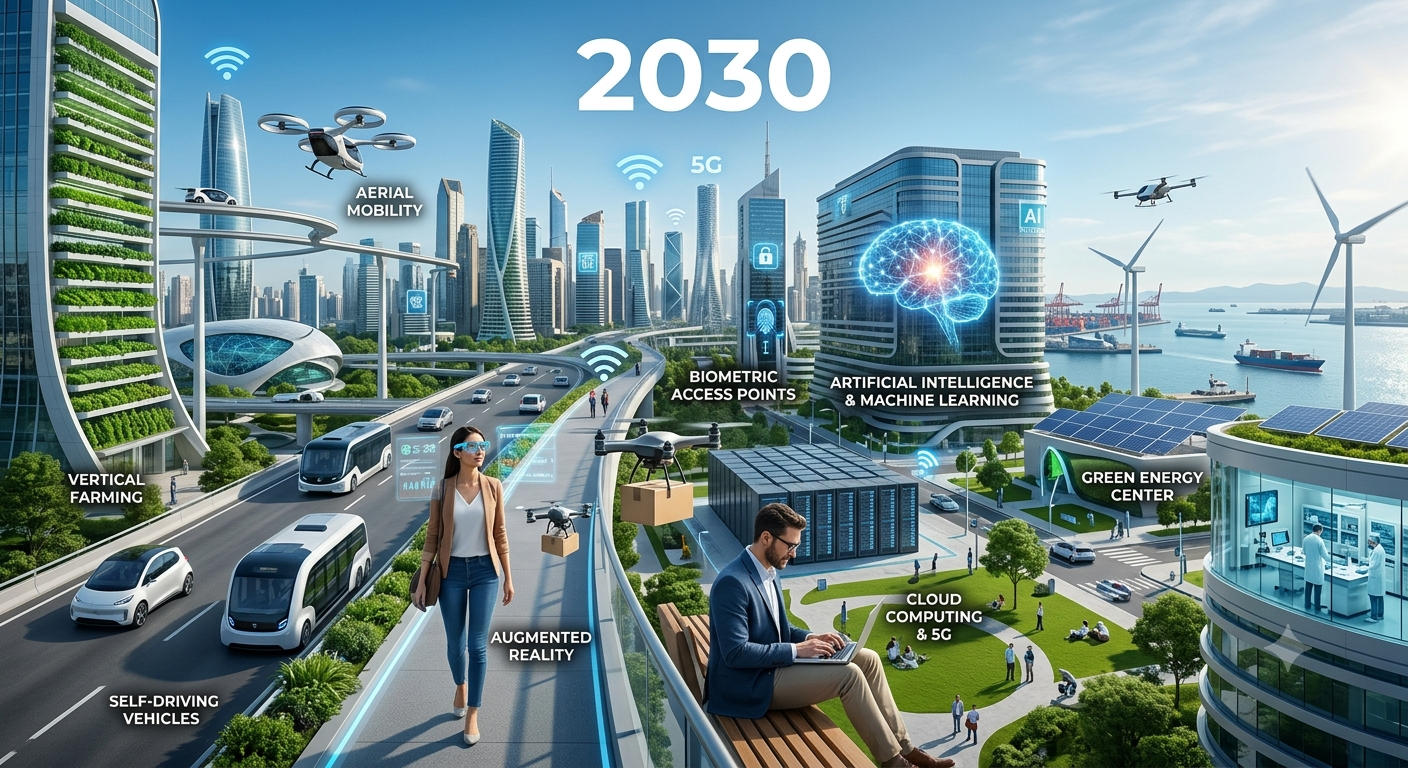
Top 10 Future Technology Trends That Will Change the World by 2030
Meta Description
Discover the top 10 future technology trends expected to transform the world by 2030, including AI, robotics, quantum computing, 6G, biotechnology, and more.
Focus Keyword: Future Technology Trends 2030
SEO Slug: future-technology-trends-2030
URL Suggestion:https://tech.menu.hunt.blog/future-technology-trends-2030
Primary Keyword: Future Technology Trends 2030
Secondary Keywords:
- Future Technology
- Technology Trends
- Emerging Technologies
- Future of AI
- Future Innovation
- Technologies of the Future
- Top Technology Trends
- Digital Transformation
- Technology Predictions
- Future Tech 2030
Estimated Reading Time: 13–15 Minutes
Top 10 Future Technology Trends That Will Change the World by 2030
Technology is advancing faster than ever before. Innovations that once seemed like science fiction are now becoming part of everyday life. Artificial Intelligence writes content, self-driving cars are being tested on public roads, robots assist in manufacturing, and quantum computers are solving problems that traditional computers struggle with.
As we approach 2030, technology will continue transforming industries, economies, and daily life. Businesses are investing billions of dollars in research and development, while governments and universities work together to accelerate innovation.
Understanding future technology trends isn’t only important for technology professionals—it also helps students, entrepreneurs, investors, and business owners prepare for the opportunities and challenges ahead.
In this guide, we’ll explore the top 10 future technology trends expected to shape the world by 2030, along with their real-world applications, benefits, and potential impact.
1. Artificial Intelligence Will Become Smarter
Artificial Intelligence (AI) is expected to become even more capable over the next few years.
Future AI systems may:
- Automate complex business processes
- Improve medical diagnosis
- Personalize education
- Enhance customer service
- Assist scientific research
- Generate realistic multimedia content
AI will increasingly work alongside humans rather than simply replacing repetitive tasks.
2. Quantum Computing Will Solve Complex Problems
Quantum computing is expected to revolutionize industries requiring enormous computational power.
Potential applications include:
- Drug discovery
- Financial modeling
- Climate simulations
- Logistics optimization
- Cybersecurity research
- Artificial Intelligence
As quantum hardware improves, businesses will gain access to computing capabilities that are currently impossible with classical computers.
3. 6G Networks Will Replace 5G
Although 5G deployment is still expanding globally, researchers are already working on 6G technology.
Expected improvements include:
- Extremely high internet speeds
- Lower latency
- Better satellite connectivity
- Smarter cities
- Enhanced virtual reality
- Improved autonomous transportation
6G could become the foundation for future digital communication.
4. Robotics Will Become More Intelligent
Modern robots already assist in manufacturing, healthcare, and logistics.
Future robots may perform tasks such as:
- Elderly care
- Surgical assistance
- Warehouse automation
- Disaster response
- Agriculture
- Home assistance
Advances in AI will make robots more adaptive and capable of working safely alongside humans.
5. Extended Reality (XR)
Extended Reality combines:
- Virtual Reality (VR)
- Augmented Reality (AR)
- Mixed Reality (MR)
By 2030, XR technologies could transform:
- Education
- Gaming
- Healthcare
- Employee training
- Retail
- Architecture
Immersive digital experiences will become increasingly common.
6. Biotechnology and Personalized Medicine
Healthcare is expected to become more personalized through biotechnology.
Emerging technologies may enable:
- Customized treatments
- Gene editing
- Faster vaccine development
- Disease prevention
- Precision medicine
These innovations could significantly improve patient outcomes.
7. Autonomous Vehicles
Self-driving technology continues advancing rapidly.
Future autonomous transportation may include:
- Driverless taxis
- Autonomous trucks
- Smart public transportation
- Delivery robots
- Automated shipping
These systems could improve road safety while reducing transportation costs.
8. Green Technology
Sustainability will become a major technology priority.
Expected innovations include:
- Renewable energy
- Carbon capture
- Smart power grids
- Electric transportation
- Energy-efficient buildings
- Sustainable manufacturing
Green technology will help reduce environmental impact while supporting economic growth.
9. Internet of Things (IoT)
The Internet of Things will continue connecting billions of devices.
Future IoT applications include:
- Smart cities
- Intelligent traffic management
- Smart agriculture
- Industrial automation
- Connected healthcare
- Smart energy systems
IoT combined with Artificial Intelligence will enable greater automation than ever before.
10. Cybersecurity Will Become More Advanced
As technology evolves, cyber threats will become increasingly sophisticated.
Future cybersecurity technologies may include:
- AI-powered threat detection
- Quantum-resistant encryption
- Zero Trust Architecture
- Automated incident response
- Biometric authentication
- Behavioral analytics
Protecting digital information will remain one of the highest priorities for organizations worldwide.
Why Future Technology Matters
Emerging technologies affect nearly every aspect of life.
Benefits include:
- Increased productivity
- Better healthcare
- Improved education
- Economic growth
- Smarter transportation
- Cleaner energy
- Enhanced communication
Understanding technology trends allows businesses and individuals to prepare for future opportunities.
Industries That Will Change the Most
Several industries are expected to experience significant transformation by 2030.
Healthcare
AI, robotics, biotechnology, and wearable devices will improve patient care.
Education
Personalized AI tutors and immersive learning environments will reshape education.
Finance
Artificial Intelligence, blockchain, and quantum computing will improve security and efficiency.
Manufacturing
Factories will become increasingly automated through robotics and Industrial IoT.
Transportation
Electric vehicles, autonomous driving, and intelligent traffic systems will improve mobility.
Agriculture
Smart farming technologies will optimize crop production while reducing resource consumption.
Challenges of Future Technologies
Despite their benefits, emerging technologies also create challenges.
Privacy
Increasing data collection raises concerns about personal privacy.
Cybersecurity
More connected devices create larger attack surfaces for cybercriminals.
Ethical AI
Organizations must ensure AI systems remain fair, transparent, and accountable.
Workforce Changes
Automation will transform many jobs, requiring workers to develop new skills.
Regulation
Governments will continue developing laws to address new technologies responsibly.
Skills Needed for the Future
Professionals should begin developing skills that align with emerging technologies.
Important skills include:
- Artificial Intelligence
- Data Analysis
- Programming
- Cloud Computing
- Cybersecurity
- Machine Learning
- Critical Thinking
- Digital Communication
- Problem Solving
Continuous learning will become increasingly important.
Frequently Asked Questions (FAQs)
What technology will dominate by 2030?
Artificial Intelligence is expected to be one of the most influential technologies, alongside quantum computing, robotics, and biotechnology.
Will robots replace humans?
Robots will automate many repetitive tasks, but human creativity, leadership, and critical thinking will remain essential.
Is quantum computing the future?
Quantum computing has enormous potential for scientific research, finance, healthcare, and Artificial Intelligence, although widespread adoption will take time.
What industries will benefit the most?
Healthcare, education, manufacturing, finance, transportation, agriculture, and energy are expected to benefit significantly from emerging technologies.
How can I prepare for future technology?
Develop digital skills, stay informed about technological trends, learn continuously, and become comfortable working with AI-powered tools.
Conclusion
The decade leading up to 2030 promises to be one of the most transformative periods in technological history. Artificial Intelligence, quantum computing, robotics, biotechnology, IoT, and sustainable innovations are expected to reshape industries, create new career opportunities, and improve the quality of life for millions of people around the world.
While these technologies offer tremendous benefits, they also introduce new challenges related to privacy, cybersecurity, ethics, and workforce adaptation. Individuals and businesses that embrace continuous learning and technological innovation will be better prepared to succeed in this rapidly changing digital landscape.
By understanding future technology trends today, you can make informed decisions, develop valuable skills, and position yourself for the opportunities of tomorrow.